Local old.reddit-style archive. No login, no quarantine splash, no new Reddit.
555 posts · 8935 comments
Chinese Borrowers Miss Bond Payments (yahoo.com)
submitted 2019-02-12 by garbotalk
[–] garbotalk 3 points 2019-02-12
(Bloomberg) -- Two large Chinese borrowers missed payment deadlines this month, underscoring the risks piling up in a credit market that’s witnessing the most company failures on record. China Minsheng Investment Group Corp., a private investment group with interests in renewable energy and real estate, hasn’t returned money to bondholders that it had pledged to repay on Feb. 1, according to people familiar with the matter. And Wintime Energy Co., which defaulted last year, didn’t honor part of a restructured debt repayment plan last week, separate people said. The developments are significant because both companies were big borrowers, and their problems accessing financing suggest that government efforts to smooth over cracks in the $11 trillion bond market aren’t benefiting all firms. If China Minsheng ends up defaulting, it may rank alongside Wintime Energy as one of China’s biggest failures, with 232 billion yuan ($34.3 billion) of debt as of June 30, according to a ratings agency report. “Chinese corporations’ expansion in the past few years has often been fueled by debt issuance, usually short-term borrowings, but their investment cycles are typically longer term,” said Shen Chen, a partner at Shanghai Maoliang Investment Management LLP. “The recent failures show that companies are still struggling to roll over their debt despite the recent easing measures.” A liquidity crunch spurred a record 119.6 billion yuan of defaults on local Chinese debt in 2018. While that number is tiny relative to China’s economy or outstanding debt, it sent shockwaves through a market where inconsistent government appetite for bailouts and the prevalence of shadow financing can make it hard to tell who’s on the hook for losses. The default total will swell again this year, according to analysts. Shanghai-based China Minsheng Investment didn’t repay investors in a 3 billion yuan bond that matured Jan. 29, then pledged to give them their money back three days late, Bloomberg News reported earlier. But that didn’t happen, the people familiar with the matter said. China’s financial markets were shut last week for the lunar new year holidays, and calls to China Minsheng Investment’s financing manager went unanswered on Monday. The firm, one of the largest private investment champions in China, was backed by 59 non-state companies and obtained an operating license in 2014, it said in a November bond prospectus. China Minsheng Investment had 232 billion yuan in total debt and 310 billion yuan of assets as of June 30, according to Shanghai Brilliance Credit Rating & Investor Service Co. Meanwhile, Wintime Energy told investors that it’s still seeking financing to repay 20 percent of the principal on a 3.8 billion yuan delinquent bond, which was meant to be returned on Feb. 6, said other people familiar with the matter, asking not to be named as the information is private. The coal miner was China’s second-largest bond defaulter in 2018, when it found itself incapable of servicing debt that had quadrupled in less than five years. Calls to Wintime Energy’s officer responsible for securities information disclosure went unanswered. China has been seeking to limit the fallout from its deleveraging campaign by adding cash to the financial system and unveiling stimulus such as increased infrastructure spending, a boon to indebted property and local government borrowers. While that’s restored demand for some risky debt, the impact has been uneven. The yield spread on five-year AA- rated notes (considered a junk score in China) is still more than 300 basis points over top-rated peers, more than twice the level of a year earlier, according to ChinaBond data. The “market is clearly pricing in a lot of credit differentiation as access to refinance remains firmly shut for certain issuers yet widely open for others," said Anne Zhang, executive director for fixed income, currencies and commodities at JPMorgan Private Bank. "Defaults will become more frequent yet more idiosyncratic."
(Bloomberg) -- Two large Chinese borrowers missed payment deadlines this month, underscoring the risks piling up in a credit market that’s witnessing the most company failures on record.
China Minsheng Investment Group Corp., a private investment group with interests in renewable energy and real estate, hasn’t returned money to bondholders that it had pledged to repay on Feb. 1, according to people familiar with the matter. And Wintime Energy Co., which defaulted last year, didn’t honor part of a restructured debt repayment plan last week, separate people said.
The developments are significant because both companies were big borrowers, and their problems accessing financing suggest that government efforts to smooth over cracks in the $11 trillion bond market aren’t benefiting all firms. If China Minsheng ends up defaulting, it may rank alongside Wintime Energy as one of China’s biggest failures, with 232 billion yuan ($34.3 billion) of debt as of June 30, according to a ratings agency report.
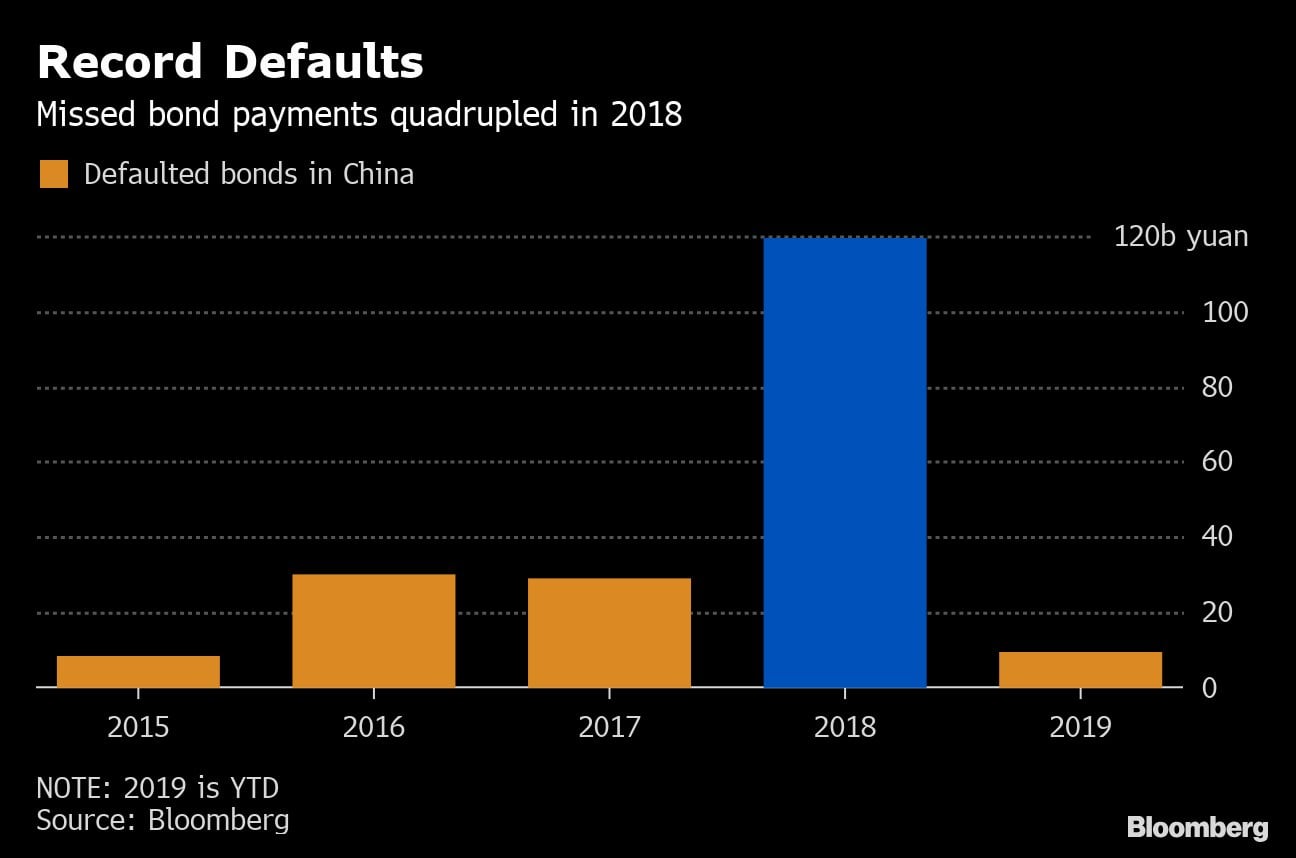
“Chinese corporations’ expansion in the past few years has often been fueled by debt issuance, usually short-term borrowings, but their investment cycles are typically longer term,” said Shen Chen, a partner at Shanghai Maoliang Investment Management LLP. “The recent failures show that companies are still struggling to roll over their debt despite the recent easing measures.” A liquidity crunch spurred a record 119.6 billion yuan of defaults on local Chinese debt in 2018. While that number is tiny relative to China’s economy or outstanding debt, it sent shockwaves through a market where inconsistent government appetite for bailouts and the prevalence of shadow financing can make it hard to tell who’s on the hook for losses. The default total will swell again this year, according to analysts.
Shanghai-based China Minsheng Investment didn’t repay investors in a 3 billion yuan bond that matured Jan. 29, then pledged to give them their money back three days late, Bloomberg News reported earlier. But that didn’t happen, the people familiar with the matter said. China’s financial markets were shut last week for the lunar new year holidays, and calls to China Minsheng Investment’s financing manager went unanswered on Monday.
The firm, one of the largest private investment champions in China, was backed by 59 non-state companies and obtained an operating license in 2014, it said in a November bond prospectus. China Minsheng Investment had 232 billion yuan in total debt and 310 billion yuan of assets as of June 30, according to Shanghai Brilliance Credit Rating & Investor Service Co.
Meanwhile, Wintime Energy told investors that it’s still seeking financing to repay 20 percent of the principal on a 3.8 billion yuan delinquent bond, which was meant to be returned on Feb. 6, said other people familiar with the matter, asking not to be named as the information is private.
The coal miner was China’s second-largest bond defaulter in 2018, when it found itself incapable of servicing debt that had quadrupled in less than five years. Calls to Wintime Energy’s officer responsible for securities information disclosure went unanswered.
China has been seeking to limit the fallout from its deleveraging campaign by adding cash to the financial system and unveiling stimulus such as increased infrastructure spending, a boon to indebted property and local government borrowers. While that’s restored demand for some risky debt, the impact has been uneven. The yield spread on five-year AA- rated notes (considered a junk score in China) is still more than 300 basis points over top-rated peers, more than twice the level of a year earlier, according to ChinaBond data. The “market is clearly pricing in a lot of credit differentiation as access to refinance remains firmly shut for certain issuers yet widely open for others," said Anne Zhang, executive director for fixed income, currencies and commodities at JPMorgan Private Bank. "Defaults will become more frequent yet more idiosyncratic."
On the surface, this doesn't seem particularly concerning. Two large Chinese companies missing consecutive bond payments isn't shocking, but it underscores the risks piling up in a credit market that’s witnessing the most company failures on record.
The volatility of the Chinese corporate investors could eventually lead to bond defaults. And the problem with that is that as of today, China owns an estimated $1.18 trillion in U.S. Treasuries, and is the number-one investor among foreign governments, according to the April 2018 figures released by the U.S. Treasury. This amounts to over 21 percent of the U.S. debt held overseas and about 7.2 percent of the United States’ total debt load.
Should China default on American Treadury bonds, it could cause a cascading effect leading to crashing the U. S. economy.
Our debt load is unsustainable. We are beholden to other nations who carry this debt. And should the Chinese default on such a heavy percent of our total debt, 7.2 and rising, it could usher in the greatest depression we have ever seen.
Reducing our debt should become a top priority. Otherwise, our national fate is entwined with the political will of nations who do not have our best interests in mind.
In fact, financial retaliation for political reasons is a definite threat to our financial future.
[–] LampsPlus1 2 points 2019-02-12
It’s all just getting worse and worse.
[–] PoeDameronski 1 points 2019-02-12
This isn't directed at you, but:
Perspective is so critical when reading these articles/posts. The folks at collapse are leaching depression from each other. It's so important to remember that it's actually NOT getting worse and worse, only our perspective is getting worse and worse IF we let it.
Changing. It's just changing. Mental vigilance is critical for folks like me who can slip into the blues after bombarding the brain with a stream of "negative" information.
Food for thought. Stay frosty.
[–] ACuriousHumanBeing 1 points 2019-02-12
We need a knowledge based currency
Currency based on tangible fact, idea
How god, how?
[–] garbotalk 1 points 2019-02-12
I've always thought etched crystal with unique file names and numbers corresponding to a data base of human ideas would work. We could start with every single book in the libraries of the world, add every musical recording, every patent or copywrite, every film, play, song, piece of art, craft, and more.
What we're talking about is auditing humanity for our uniqueness in our creations. There must be trillions and trillions of sources specific to each nation.
[–] exicleus 1 points 2019-02-13
Years ago I was measuring ohms Ω of the human body and how that impacts both energy and electrons. It is information to a part of who we are. I was also observing at how light hits a crystal and breaks it into different shards.
A vision hit me that this was a part of our future. Information could be written in light and it may look something like this.
[–] HolofractalFox 1 points 2019-02-12
As long as fractional reserve lending exists we are going to have money (control) issues.
[–] garbotalk 2 points 2019-02-13
https://www.yahoo.com/news/national-debt-tops-22-trillion-214033190.html
And our debt rises to 22 trillion.
The stage is set for a massive economic downturn that will create devastating hardship for us.
[–] garbotalk 3 points
[–] LampsPlus1 2 points
[–] PoeDameronski 1 points
[–] ACuriousHumanBeing 1 points
[–] garbotalk 1 points
[–] exicleus 1 points
[–] HolofractalFox 1 points
[–] garbotalk 2 points